
Lesson 1: Overview of the Infectious Disease Process
Infectious Diseases – An Introduction Video
Click on the link provided below to watch the required video.
https://www.youtube.com/watch?v=9axOFtPqS0c
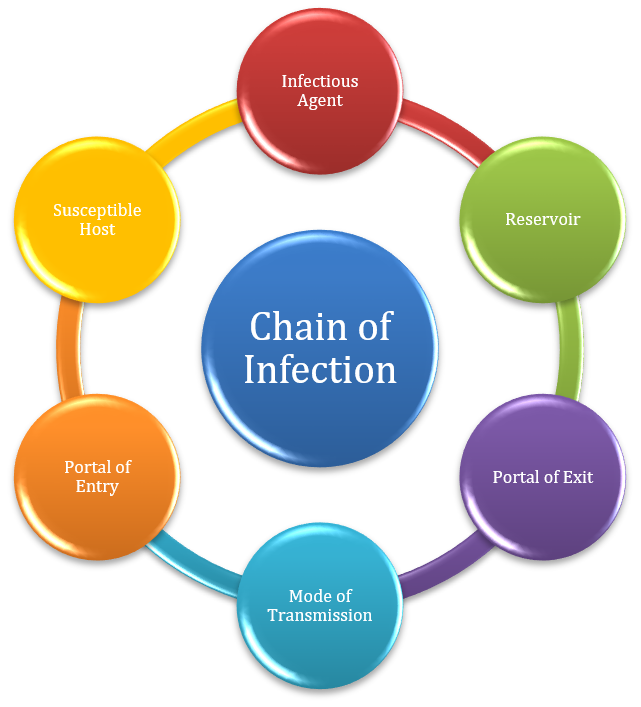
The Chain of Infection comprises of a series of vital links that causes infectious diseases; namely, a pathogen (infectious agent or germ), reservoir (human, animal, environmental), portal of exit, mode of transmission, portal of entry, and susceptible host.
Pathogen or infectious agent: A germ, biological, physical, or chemical organism capable of causing disease. Biological agents may be bacteria, viruses, or fungus.
Portal of entry: The means by which an infectious agent enters the susceptible host. Port of entry sites include lungs, stomach and intestines, sex organs, urinary tract, skin/mucous membrane, placenta, and blood.
Portal of exit: The path by which an infectious germ leaves where it lives. Pathogens or germs can infect its host (person or animal) from drainage, excretions, and secretions.
Reservoir: Place in which an infectious agent can survive but may or may not multiply. Workers may also be reservoirs for a number of organisms.
Susceptible host: A person or animal not possessing sufficient resistance to a particular infectious agent to prevent contracting infection or disease when exposed to the germ.
Transmission: how germs is spread by a source or reservoir to a person.
Common vehicle: Contaminated material, product, or substance that serves as a means to carry to a susceptible host (person or animal) through a suitable portal of entry (cut, nose, eyes, mouth etc.).
Acute infection: infections that come and go rapidly
Chronic infection: infections that develop more slowly and last longer
Infections Exposure
The responsibility to follow infection control standards is the responsibility of all employees. Employees must adhere to infection control standards to protect the public, provide safe workspaces, and to prevent and contain infections, epidemics, and pandemics.
It is important that employees prevent the risk of infection by breaking the chain of infection via hand washing, cleaning, and sanitizing or disinfecting. Besides all the factors included in the Chain of Infection, the host or person’s immunity (the body’s ability to fight infections) and his or her general health are factors. The infectious disease process is affected by the person’s ability to fight off infections. Chronic illness (such as diabetes, high blood pressure) medications, certain treatments can lower the body’s ability to fight infections and make the person easily catch infectious diseases.
The human host has natural barriers (such as unbroken/uncut skin, lining of the lungs, stomach acid and movement, flow of urine, tears, and normal bacteria that live in the body) which can protect them from infectious diseases. Also, the body provides a response to protect itself by healing or removing unwanted germs.
Factors that influence exposure to germs and getting sick are:
- Virulence – the ability of germs to produce an infectious disease in an organism. Virulence is the ability for organisms to invade the blood and it describes the degree of damage caused by the germ.
- Size of inoculums refers to the size of a substance (a virus) that is introduced into the body to produce or increase protection to a particular disease. The larger the size of exposure, the more potential germs are introduced.
- Route of exposure refers to the different types of ways to get an infection; for instance, some germs spread quicker when they enter the body by certain routes such as the eyes, nose, mouth, skin, and throat
- Duration of exposure refers to the length of time that the germ was introduced to the body. The longer the duration, the more germs that can be introduced.
- Environmental factors also affect the exposure outcomes. Dirty or contaminated environments encourage germ growth and spread, especially since most microbes are tiny.
Immune System: Innate and Adaptive Immunity Video
Click on the link provided below to watch the required video.
https://www.youtube.com/watch?v=PzunOgYHeyg