
Lesson 10
The Do’s
- Stop the bullying immediately. Stop the interaction between the targeted student and the alleged offender. Don’t send any bystanders away. To avoid escalating the tension, wait until later to sort out the facts. Talk to the parties involved separately once they are calm.
- Refer to school rules regarding bullying. Speak in a matter-of-fact tone of voice to describe what you heard or saw. Let all students know bullying is always unacceptable.
- Support the targeted child. Do this in a way that allows him or her dignity and to feel safe from retaliation. Make a point to see the child later in private if he or she is upset. Increase supervision to assure bullying is not repeated.
- Offer guidance to bystanders. Let them know how they might appropriately intervene or get help next time. Tell them you noticed their inaction or that you’re pleased with the way they tried to help.
- Impose immediate consequences. Wait until all parties have calmed down. Do not require that students apologize or make amends that may be insincere. The consequences should be logical and connected to the offense. A first step could be taking away social privileges i.e. recess.
- Notify colleagues and parents (if advised, possible). Let the alleged offender know he or she is being watched.
- Follow up and intervene as necessary. Support the targeted student and alleged offender, enabling them to vent feelings and recognize their own behavior. The bully may need to learn new methods of using his or her power and influence in the classroom.
The Don’ts
- Do not confuse bullying with conflict. Bullying is a form of victimization, and addressing it as a “conflict” downplays the negative behavior and the seriousness of the effects. Educators should strive to send the message that “no one deserves to be bullied,” and to let the alleged offender know the behavior is wholly inappropriate.
- Do not use peer mediation. It can be very upsetting for a child who has been bullied to face his or her tormentor in mediation. Giving both parties an equal voice can empower the bully and make the bullied student feel worse. In addition, there is no evidence that peer mediation is effective in stopping bullying.
- Do not use group treatment for bullies. Some schools use therapeutic strategies such as anger management, skill-building, empathy-building and self-esteem building to reach the bully. In practice, group members can actually reinforce each others’ bullying and antisocial behavior.
Creating an Inclusive Environment
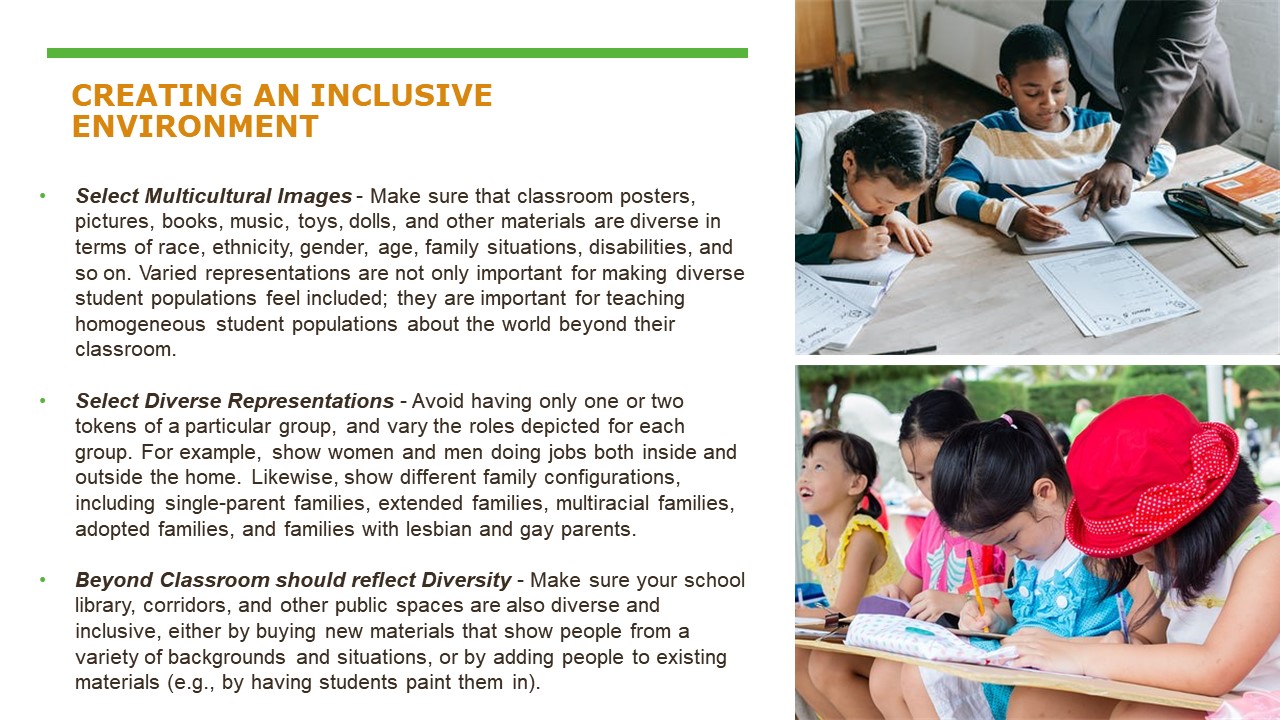
- Select Multicultural Images – Make sure that classroom posters, pictures, books, music, toys, dolls, and other materials are diverse in terms of race, ethnicity, gender, age, family situations, disabilities, and so on. Varied representations are not only important for making diverse student populations feel included; they are important for teaching homogeneous student populations about the world beyond their classroom.
- Select Diverse Representations – Avoid having only one or two tokens of a particular group, and vary the roles depicted for each group. For example, show women and men doing jobs both inside and outside the home. Likewise, show different family configurations, including single-parent families, extended families, multiracial families, adopted families, and families with lesbian and gay parents.
- Beyond Classroom should reflect Diversity – Make sure your school library, corridors, and other public spaces are also diverse and inclusive, either by buying new materials that show people from a variety of backgrounds and situations, or by adding people to existing materials (e.g., by having students paint them in)
Create a New Culture
- Everyone must Participate – Try to involve other supportive teachers, administrators, staff members so that you are not the only one modeling a concern for inclusive classrooms and school settings.
- Consciously Choose Images – If biased materials remain visible, use them as opportunities to teach children to think about issues of bias. For example, you might ask students to tell you how the item in question would make a target of bias feel, or you might use the item to explain how to identify instances of bias.
- Check Language – Make a special effort to use language that is unbiased, inclusive, and does not divide students unnecessarily. For example, “Okay everyone…” is less likely to reinforce gender divisions than “Okay, boys and girls…”
- Check Unconscious Messaging – Be careful not to unwittingly contribute to gender discrimination. If girls are complimented on appearance and boys on achievement, girls will soon learn that female achievement is of secondary importance
Addressing Children’s Questions and Concerns
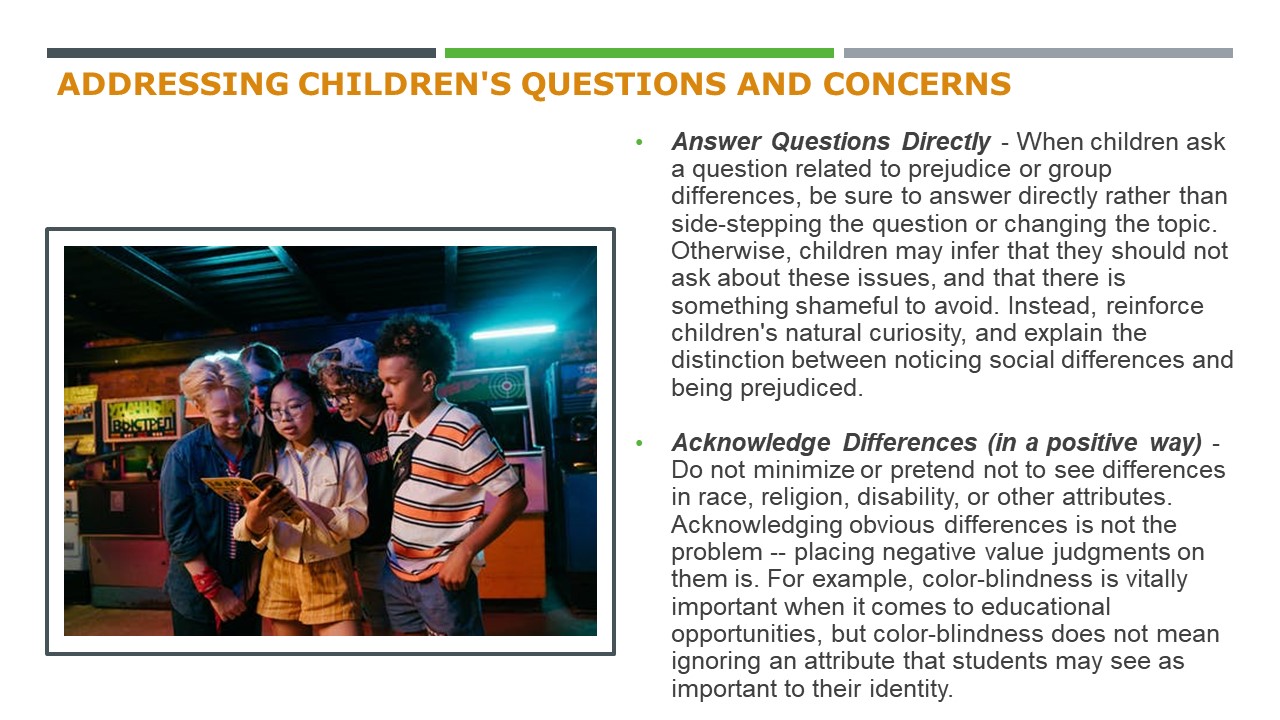
- Answer Questions Directly – When children ask a question related to prejudice or group differences, be sure to answer directly rather than side-stepping the question or changing the topic. Otherwise, children may infer that they should not ask about these issues, and that there is something shameful to avoid. Instead, reinforce children’s natural curiosity, and explain the distinction between noticing social differences and being prejudiced.
- Acknowledge Differences (in a positive way) – Do not minimize or pretend not to see differences in race, religion, disability, or other attributes. Acknowledging obvious differences is not the problem — placing negative value judgments on them is. For example, color-blindness is vitally important when it comes to educational opportunities, but color-blindness does not mean ignoring an attribute that students may see as important to their identity.
Learning Opportunities
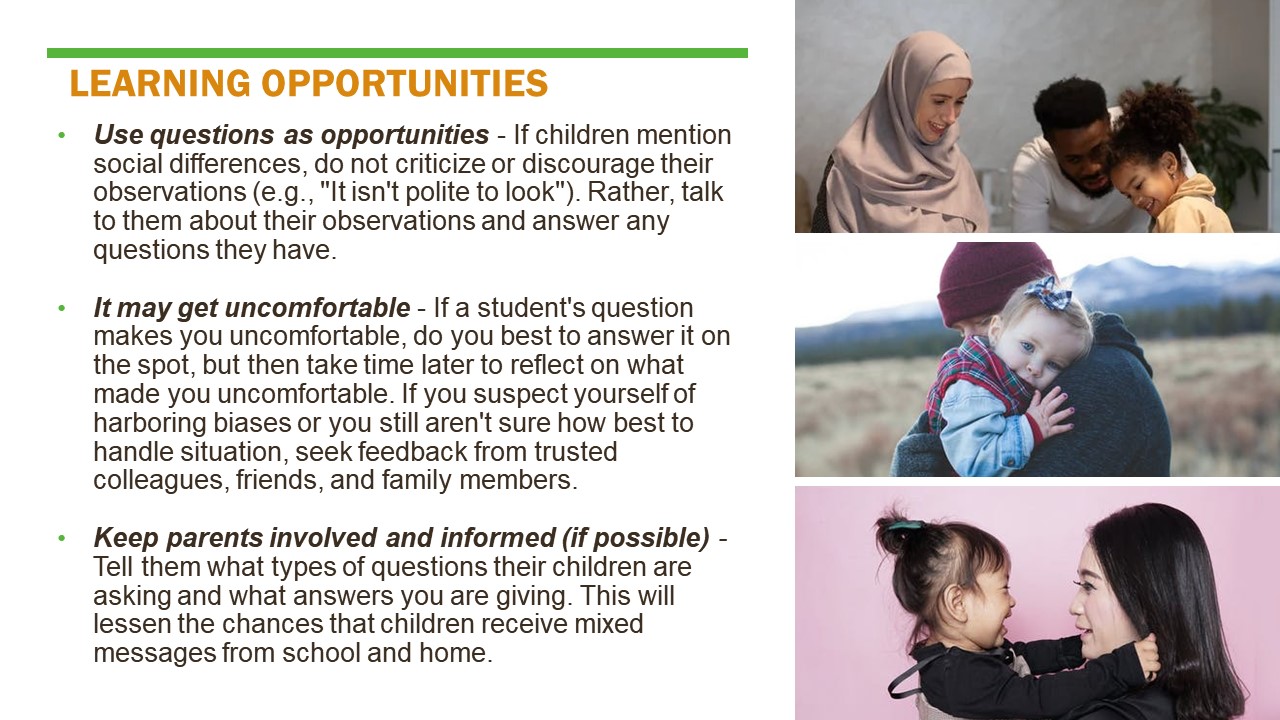
- Use questions as opportunities – If children mention social differences, do not criticize or discourage their observations (e.g., “It isn’t polite to look”). Rather, talk to them about their observations and answer any questions they have.
- It may get uncomfortable – If a student’s question makes you uncomfortable, do you best to answer it on the spot, but then take time later to reflect on what made you uncomfortable. If you suspect yourself of harboring biases or you still aren’t sure how best to handle situation, seek feedback from trusted colleagues, friends, and family members.
- Keep parents involved and informed (if possible) – Tell them what types of questions their children are asking and what answers you are giving. This will lessen the chances that children receive mixed messages from school and home
Integrating Children’s Own Experiences
- Model Inclusiveness – Use whatever diversity exists among your students to model inclusiveness. For example, if students are about to do an activity that is difficult for a disabled student to do, invite students to help adapt the activity so that everyone can participate. Under the right circumstances, such an approach can establish a norm of inclusiveness and reward students for valuing each other’s participation.
- Select words and examples carefully – Be sure not to single out minority students or call on them unsolicited to represent their group. When discussing families, cultures, lifestyles, and social groups, vary the focus and the order of presentation to avoid implicitly conveying an order of importance (e.g., use “she or he” as well as “he or she”).
Avoid
- Avoid a “tourist approach” to multiculturalism that limits diversity to holidays, special events, and history months. Instead, integrate various cultures and backgrounds into the everyday life of the classroom, and invite students to enrich discussions with their own ethnic traditions and experiences.
- Avoid segregation – If you notice gender or racial segregation during play times, reorganize the activities or play area to foster integration and reduce stereotypes. For example, if girls gravitate toward playing house and dressing up, relocate woodworking tools near the house for home repairs, and include dress-up props such as a doctor’s bag, police badge, tool belt, or hard hat.
Dealing With Discriminatory Behavior
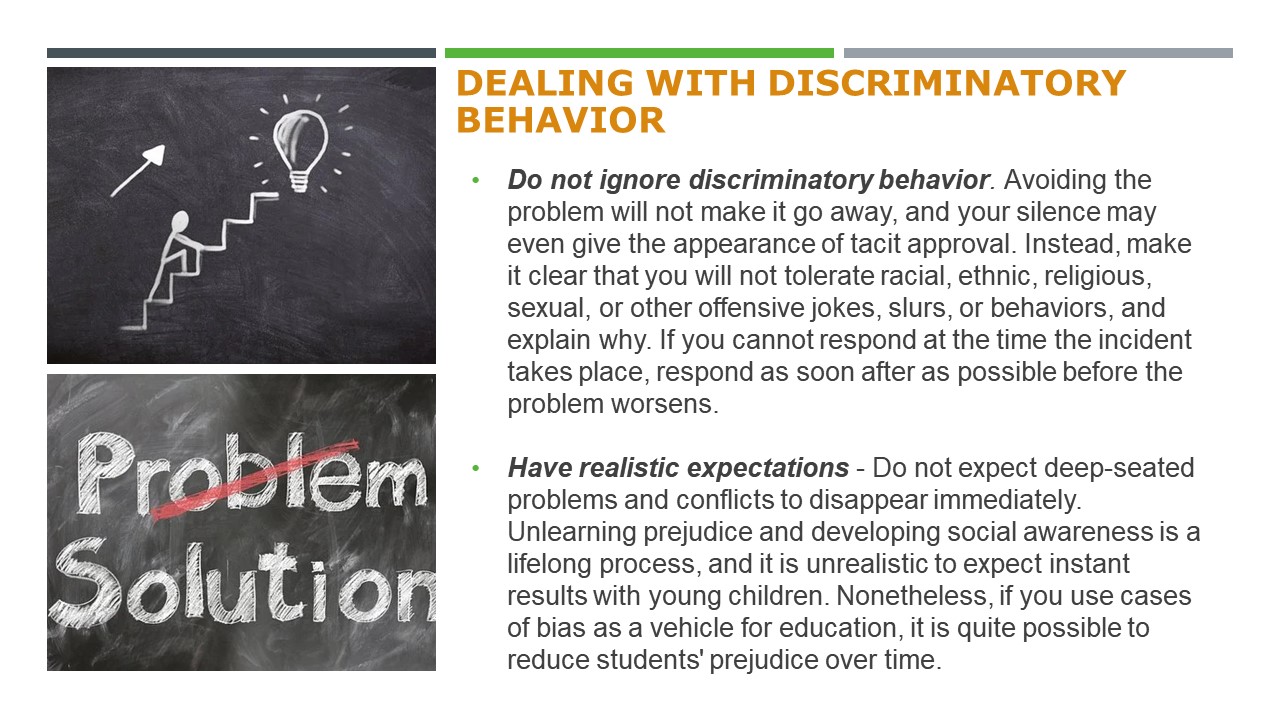
- Do not ignore discriminatory behavior. Avoiding the problem will not make it go away, and your silence may even give the appearance of tacit approval. Instead, make it clear that you will not tolerate racial, ethnic, religious, sexual, or other offensive jokes, slurs, or behaviors, and explain why. If you cannot respond at the time the incident takes place, respond as soon after as possible before the problem worsens.
- Have realistic expectations – Do not expect deep-seated problems and conflicts to disappear immediately. Unlearning prejudice and developing social awareness is a lifelong process, and it is unrealistic to expect instant results with young children. Nonetheless, if you use cases of bias as a vehicle for education, it is quite possible to reduce students’ prejudice over time.
Responsibility and Action
- Do not humiliate prejudiced students who make mistakes or behave badly. Humiliating students is not only unkind, it often deepens their feelings of resentment and rivalry without addressing the underlying causes of prejudice. The best approach is a compassionate effort to understand what went wrong and what might be done to avoid similar episodes in the future.
- Empathy Training – Make empathy training as central to your lesson plans as reading, writing, and arithmetic. Empathy can be taught effectively with role-playing and role-reversal exercises, and research suggests that greater empathy is significantly associated with reductions in prejudice, aggression, and interpersonal conflict.
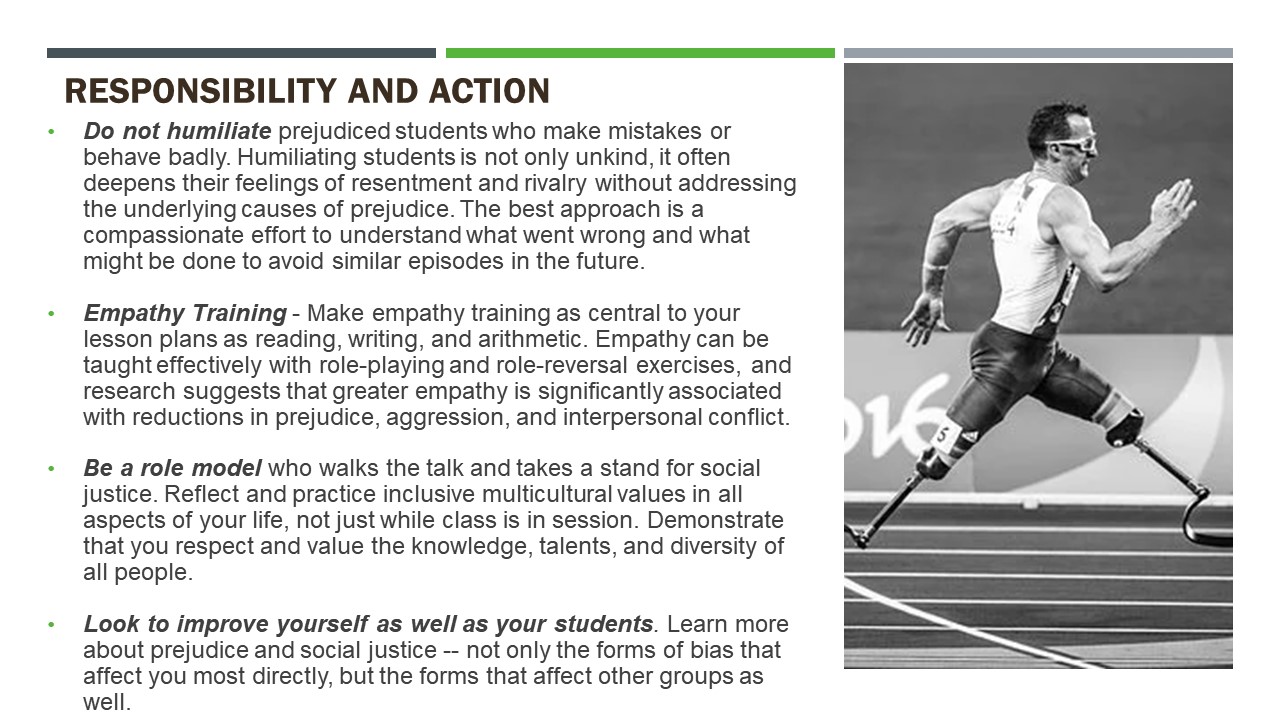
- Be a role model who walks the talk and takes a stand for social justice. Reflect and practice inclusive multicultural values in all aspects of your life, not just while class is in session. Demonstrate that you respect and value the knowledge, talents, and diversity of all people.
- Look to improve yourself as well as your students. Learn more about prejudice and social justice — not only the forms of bias that affect you most directly, but the forms that affect other groups as well