
Lesson 2
Understanding How School Climate and Culture Have an Impact on Student Achievement and Behavior
- Participants will understand the relationship between harassment, bullying, cyberbullying, microaggression, marginalization, and discrimination on student achievement, attendance and dropout rates.
- Participants will understand the direct relationship between harassment, bullying, cyber bullying, and discrimination and a negative school climate as it relates to a student’s readiness for learning.
- Participants will understand how harassment, bullying, cyber bullying, and discrimination affect student achievement.
The Dignity Act: Staff Training Goal
- Raise awareness & sensitivity of ALL employees to potential discrimination and harassment
- Enable employees to prevent and respond to discrimination and harassment
- At least one employee in each school must be trained to be the Dignity Act Coordinator.
- The Dignity Act Coordinator must be accessible to students and other employees for consultation and advice – as needed
- There is no requirement to hire a new employee to fulfill this role – an existing person may receive the training
The Dignity for All Students Act impacts what students learn concerning bullying, harassment and discrimination.
- Education Law § 801-a – Instruction in Civility, Citizenship, and Character Education
- Grades K-12
- Honesty, tolerance, personal responsibility, respect for others, observance of laws, courtesy, dignity.
- Races
- Weights
- National origins
- Ethnic groups
- Religions
- Religious practices
- Mental or physical abilities
- Sexual orientations
- Gender identity
- Sexes
To implement the Dignity Act in a meaningful manner, an evolving school climate and culture which supports social and emotional development and learning must be proactively supported and nurtured throughout the entire school day and the school year – www.p12.nysed.gov/sss/sedl
- The Dignity Act also requires that at least one staff member at every school (also known as a Dignity Act Coordinator) be designated and trained to handle human relations in the areas of: race, color, weight, national origin, ethnic group, religion, religious practice, disability, sexual orientation, gender, and sex.
Building a Safe School Environment
- A safe school environment needs to encompass the entire school community – including the classroom, cafeteria, library, restrooms, the school bus, the nurse’s office, and the playground.
- Everyone at school needs to work together to create a climate where bullying is not acceptable.
A key aspect of the Dignity Act is creating and fostering an atmosphere where children can learn in a safe and supportive school climate. Therefore, to implement the Dignity Act in a meaningful manner, an evolving school climate and culture which supports social and emotional development and learning must be proactively supported and nurtured throughout the entire school day and the school year. In 2011, the New York State Board of Regents adopted voluntary Guidelines and Resources for Social and Emotional Development and Learning.
Definitions
-
- HARASSMENT: Harassment covers a wide range of behaviors of an offensive nature. It is commonly understood as behavior which disturbs or upsets, and it is characteristically repetitive. In the legal sense, it is behavior which appears to be threatening or disturbing. Harassment is unwelcome conduct that is based on race, color, religion, sex (including pregnancy), national origin, age (40 or older), disability or genetic information.
- DISCRIMINATION: Discrimination is the practice of unfairly treating a person or group of people differently from other people or groups of people
- BULLYING: The use of force, threat, or coercion to abuse, intimidate, or aggressively dominate others. The behavior is often repeated and habitual.
- Bullying can result in physical injury, social and emotional distress, and even death.
- Victimized youth are at increased risk for mental health problems such as depression and anxiety, psychosomatic complaints such as headaches, and poor school adjustment.
- Youth who bully others are at increased risk for substance use, academic problems, and violence later in adolescence and adulthood.
- CYBERBULLYING
- Harassment or bullying through any form of electronic communication which:
- Has or would have the effect of unreasonably and substantially interfering with a student’s educational performance, opportunities or benefits, or mental, emotional or physical well-being;
- Reasonably causes or would reasonably be expected to cause a student to fear for his or her physical safety;
- Reasonably causes or would reasonably be expected to cause physical injury or emotional harm to a student;
- Occurs off school property and creates or would foreseeably create a risk of substantial disruption within the school environment, where it is foreseeable that the conduct, threats, intimidation, or abuse might reach school property.
- Acts of harassment and bullying shall include, but not be limited to, those acts based on a person’s actual or perceived race, color, weight, national origin, ethnic group, religion, religious practice, disability, sexual orientation, gender, or sex.
- Harassment or bullying through any form of electronic communication which:
- MARGINALIZATION: The process whereby something or someone is pushed to the edge of a group and accorded lesser importance. This is predominantly a social phenomenon by which a minority or sub-group is excluded, and their needs or desires ignored.
- MICROAGGRESSIONS: The everyday verbal, nonverbal, and environmental slights, snubs, or insults, whether intentional or unintentional, that communicate hostile, derogatory, or negative messages to target persons based solely upon their marginalized group membership.
- Examples of Microaggression:

- “Where are you from or where were you born?” “You speak English very well.”
You are not a true American. - “What are you? You’re so interesting looking!”
You are a perpetual foreigner in your own country. - “You are a credit to your race.” “Wow! How did you become so good in math?”
People of color are generally not as intelligent as Whites. - “When I look at you, I don’t see color.” “There is only one race, the human race.”
Assimilate to the dominant culture. Denying the significance of a person of color’s racial/ethnic experience and history.
- “Where are you from or where were you born?” “You speak English very well.”
- Examples of Microaggression:
Impact of Bullying
- Education – Bullying can negatively impact a child’s access to education and lead to:
- School avoidance and higher rates of absenteeism
- Decrease in grades
- Inability to concentrate
- Loss of interest in academic achievement
- Increase in dropout rates
- Health – Bullying can also lead to physical and mental health problems, including:
- Headaches and stomachaches
- Sleeping problems
- Low self-esteem
- Increased fear or anxiety
- Depression
- Post traumatic stress
- Safety – Bullying also impacts student sense of well-being, such as:
- Self-isolation
- Increased aggression
- Self-harm and suicidal ideation
- Feeling of alienation at school
- Fear of other students
- Retaliation
- Over 3.2 million students are victims of bullying each year.
- Approximately 160,000 teens skip school every day because of bullying.
- 17% of American students report being bullied 2 to 3 times a month or more within a school semester. Take a stand in your community by hosting a Bullying Policy Makeover event customizing your school’s anti-bullying policy.
- 1 in 4 teachers see nothing wrong with bullying and will only intervene 4% of the time.
- By age 14 less than 30% of boys and 40% of girls will talk to their peers about bullying.
- Over 67% of students believe that schools respond poorly to bullying, with a high percentage of students believing that adult help is infrequent and ineffective.
- 71% of students report incidents of bullying as a problem at their school.
- 90% of 4th through 8th graders report being victims of bullying.
- 1 in 10 students drop out of school because of repeated bullying.
- As boys age they are less and less likely to feel sympathy for victims of bullying. In fact they are more likely to add to the problem than solve it.
- Physical bullying increases in elementary school, peaks in middle school and declines in high school. Verbal abuse, on the other hand, remains constant.
Bullying, harassment, and discrimination cause a variety of problems and issues to students and unsafe environments.
Next are examples of research conducted examining the effect of bullying, harassment, and discrimination.
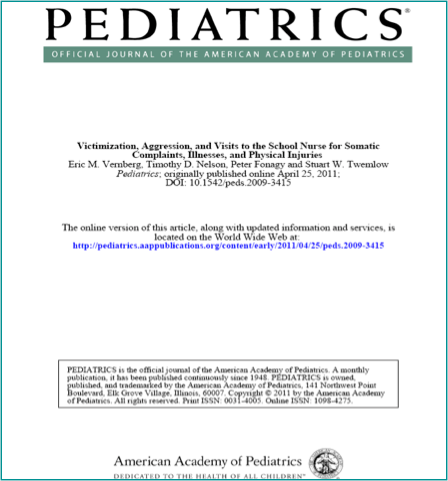
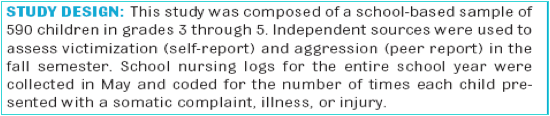
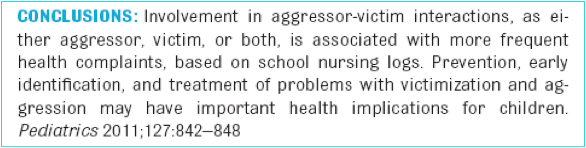
A study published in the Journal of Pediatrics documented the increased incidents of trips to the school nurses’ office by students who are bullied. (http://pediatrics.aappublications.org/content/early/2011/04/25/peds.2009-3415.full.pdf)
Research Details

Bullying and Federal Civil Rights Violations
- School districts may violate Federal civil rights statutes and U.S.E.D. regulations when peer harassment based on race, color, national origin, sex, or disability is sufficiently serious that it creates a hostile environment and such harassment is encouraged, tolerated, not adequately addressed, or ignored by school staff.
U.S. Court of Appeals, 2nd Circuit Court Decision
- Zeno v. PPCSD, case decided December 3, 2012
- Award of damages of $1.0 million to Anthony Zeno pursuant to Title VI of the Civil Rights Act of 1964 (damages were originally $1.25 million)
- Facts of the Case
- Anthony Zeno (dark skinned bi-racial – half Latino and half white) transferred from a school on Long Island to the PPCSD during 9th grade
- He was racially harassed for the next 3½ years by other students
- School district was found to be “deliberately indifferent to his harassment.”
- The high school was “a racially homogenous school were minorities represented less than 5% of the student population.”
- Anthony was repeatedly harassed and threatened – both physically and verbally which included calling him a “n…”, hanging a noose in a tree, threatening to lynch him, and rape his sister
- Students were suspended and family had order of protection
- NAACP offered to hold racial sensitivity programs at no cost – which the school district declined
- Anthony was eventually given an IEP because he was “struggling with acceptance in the school environment.
- Title IX officer never followed-up or responded to any complaints
- Mediation was arranged between students and Anthony, but Mrs. Zeno wasn’t informed – and mediator had no training in bias or diversity issues
- A staff training session was held to address bullying – but racial harassment was not discussed or addressed
- Anthony graduated with an IEP diploma
A survey conducted by (Gay, Lesbian, and Straight Education Network) in 2009 revealed that more than 1/3 of LGBT students in New York State stated that harassment, bullying, and name calling are serious problems in their schools. This included harassment based on a person’s weight, physical appearance, and their actual OR PERCEIVED sexual orientation.