
Chapter 6 – The Sequence of Crisis Management
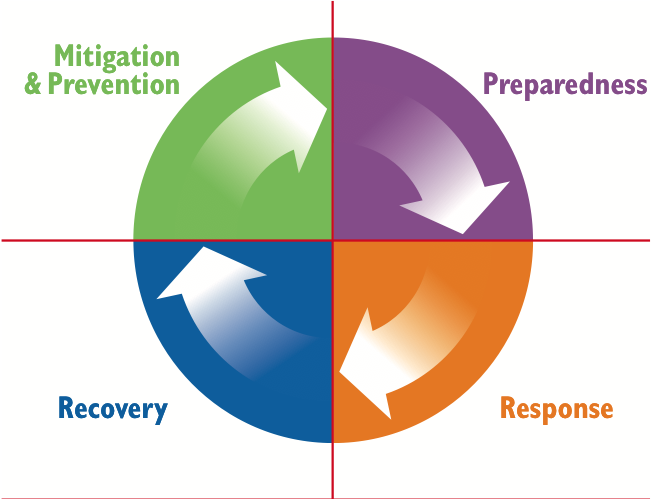
The results of extensive interviews and a review of the crisis literature reveal that experts employ four phases of crisis management:
- Mitigation/Prevention addresses what schools and districts can do to reduce or eliminate risk to life and property.
- Preparedness focuses on the process of planning for the worst-case scenario.
- Response is devoted to the steps to take during a crisis.
- Recovery deals with how to restore the learning and teaching environment after a crisis.
Crisis management is a continuous process in which all phases of the plan are being reviewed and revised. Good plans are never finished. They can always be updated based on experience, research, and changing vulnerabilities. Districts and schools may also be in various stages of planning.
Mitigation
The Federal Emergency Management Agency (FEMA) has done considerable work to help states and communities in the area of mitigation planning. It notes that the goal of mitigation is to decrease the need for response as opposed to simply increasing response capability.
“[Mitigation is] any sustained action taken to reduce or eliminate long-term risk to life and property from a hazard event. Mitigation […] encourages long-term reduction of hazard vulnerability” (FEMA, 2002).
Mitigating emergencies is also important from a legal standpoint. If a school, district, or state does not take all necessary actions in good faith to create safe schools, it could be vulnerable to a suit for negligence. It is important to make certain that the physical plant is up to local codes as well as federal and state laws.
Mitigating or preventing a crisis involves both the district and the community. Contact the regional or state emergency management office to help get started and connect to efforts that are under way locally.
Prevention
Creating a safe and orderly learning environment should not be new to any school and district. Identifying students (or in some cases staff) who may pose a danger to themselves or to others is sometimes called “threat assessment.” The results of a threat assessment may guide prevention efforts, which may help avoid a crisis.
Many schools have curricula and programs aimed at preventing children and youth from initiating harmful behaviors. Social problem-solving or life skills programs, anti-bullying programs, and school-wide discipline efforts are common across the nation as a means of helping reduce violent behavior. The staff in charge of prevention in a school (counselors, teachers, health professionals, administrators) should be part of the crisis planning team.