
Talking With Children
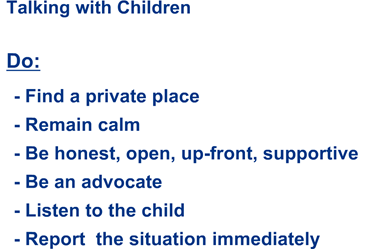
Please review handouts.
CAUTION: When dealing with child abuse or maltreatment, you are not to investigate or interrogate. Your responsibility is to assess for reasonable cause to suspect and make the necessary report.
- Occasionally you learn of possible abuse or maltreatment not by what you see, but by what a child says.
- When a child discloses, consider the suggestions or “dos” for talking with children.
- When talking with a child, stress that the situation and the behaviors are not his or her fault.
- You are NOT legally required to inform parents or other persons legally responsible for a child’s care that you are making a report to the SCR.
- Do NOT assume a parent will support the child. If you have questions or concerns about whether to inform the parents, contact your local CPS (refer to Local CPS tab).
- Informing the parent or other person legally responsible may place a child at further risk of harm.
- There are specific guidelines that apply to cases of suspected sexual abuse. Once a child reveals information that makes you suspect sexual abuse, avoid talking in detail with the child about the incident. Often CPS and law enforcement work together to interview a child at the same time. These professionals have been specially trained in interviewing children. This is a traumatic experience for a child to relive. In your role as a mandated reporter, try to minimize how much you talk to a child about an incident involving suspected sexual abuse.