
Maltreatment/Neglect
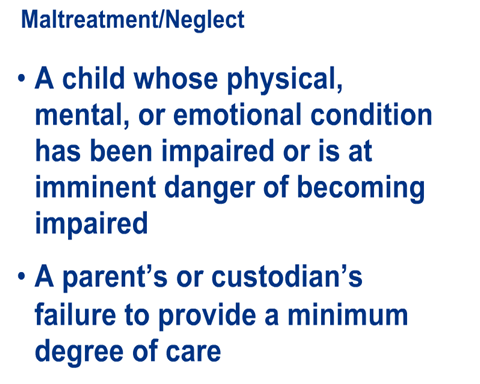
In NYS, while reasonable physical correction of a child is allowed, excessive corporal punishment is not. “Excessive” is a case-by-case determination based on the form of punishment, its ability to cause serious injury, the purpose of the punishment, and what the child did to warrant such punishment. More specifically, the following questions should help focus mandated reporters’ thought processes or a class discussion. A “yes” response to any of these questions may make a physical punishment excessive.
- Does the child (based on age, maturity, physical/mental condition) lack the capacity to understand the corrective quality of the discipline?
- Is a less severe method of punishment available and likely to be effective?
- Is the punishment unnecessarily degrading to the child?
- Was the punishment inflicted for gratification of the parent’s rage?
- Was the punishment brutal?
- Did the punishment last for such a time that it surpassed a child’s power of endurance?
An example may clarify this point:
A parent slaps their twelve year old son for being disrespectful. The child did not sustain any bruises. This type of discipline would not be considered “excessive.” A parent slaps their twelve year old son for being disrespectful. As a result of this level of physical discipline, the child sustained a bruise and slight laceration on the right side of his cheek. This type of discipline would be a registered report.
REMINDER: The terms “maltreatment” and “neglect” are often used interchangeably. Both terms have legal foundation in the CPS system. “Maltreatment” is the term used in the Social Service Law and “neglect” is used in the Family Court Act.
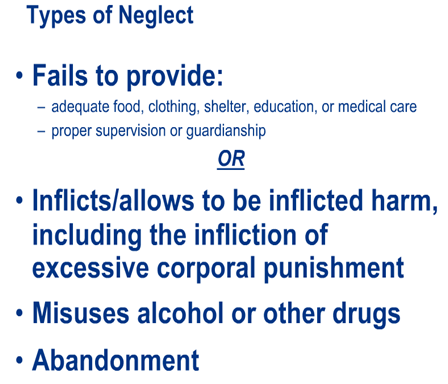
“Maltreatment” as defined by the Social Service Law includes:
A. A child whose physical, mental, or emotional condition had been impaired or placed in imminent danger of impairment
AND
B. The subject failed to exercise a minimum degree of care:
1. In supplying adequate food, clothing, or shelter, or
2. In supplying adequate education, or
3. In supplying medical or dental care through financially able to do so or offered financial or other reasonable means to do so, or
4. In providing proper supervision or guardianship, or
5. By inflicting excessive corporal punishment, or
6. By misuse of drugs or alcohol
AND
C. There is a casual connection between the child’s condition and the subject’s failure to exercise a minimum degree of care.
OR
D. The parent has abandoned the child by demonstrating an intent to forego his or her parental rights and obligations by failing to visit the child or communicate with the child though able to do so.
Key Points:
- The Abandoned Infant Protection Act (AIPA) does NOT affect your responsibilities of mandated reporter.
- AIPA does NOT amend the law in regard to mandated reporters or does NOT in any way change or lessen the responsibilities of mandated reporters.
- Mandated reporters who learn of abandonment are still obligated to fulfill their legal responsibility.
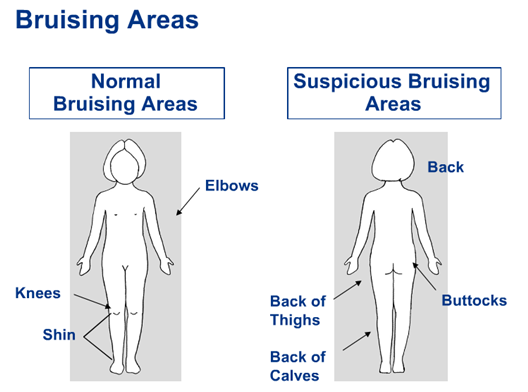
Review areas on the figure where an injury is most likely to be inflicted versus where accidental injuries usually occur.
- In addition to location, one needs to consider the size and the shape of the injury.
- Children are susceptible to injuries in relation to their developmental stage.
- If a plausible explanation is offered, consider the age of the child and the location of a suspicious injury when developing your thoughts about “reasonable cause to suspect.”
- This graphic on the left side of this slide illustrates normal and suspicious bruising areas. Note the “normal” areas versus the “suspicious” areas.
- Accidental injuries usually involve injury to the boney prominences of the body, i.e., shins, elbows, knees. For example:
– Toddlers fall while learning to walk.
– Young children “skin” elbows and knees when learning to ride a bicycle.
- Suspicious injuries usually occur in areas not susceptible to accidental, age appropriate areas.